



Why Understanding Market Analysis for Homes Matters
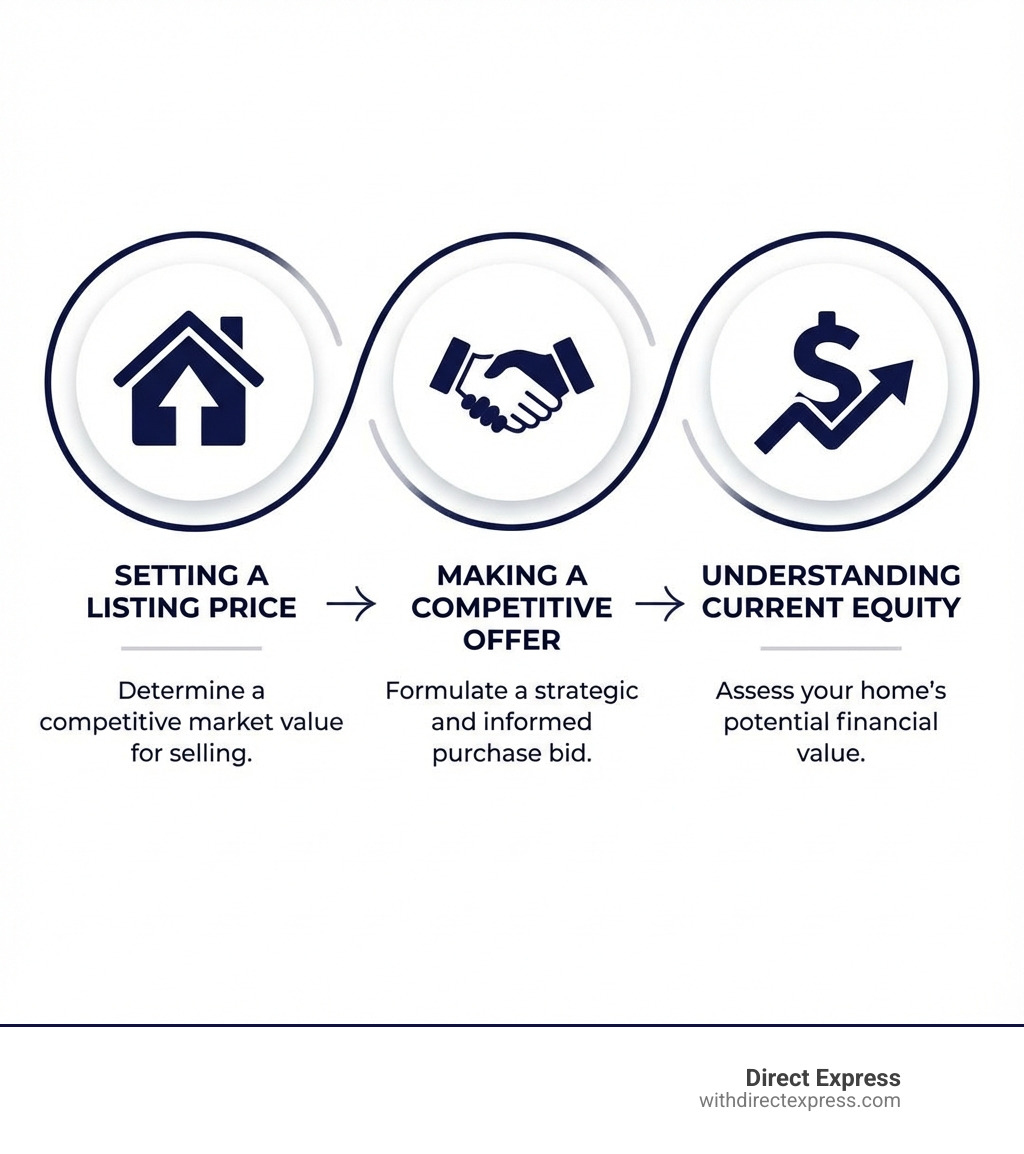
Market analysis for homes is the process of evaluating a property’s value by comparing it to similar homes that have recently sold, are currently for sale, or are under contract in the same area. This analysis, typically delivered through a Comparative Market Analysis (CMA), helps you:
- Set a competitive listing price if you’re selling
- Make an informed offer if you’re buying
- Understand your home’s current equity if you’re refinancing or investing
- Avoid overpaying or underpricing by thousands of dollars
You can’t know what your home is truly worth by guessing. While online estimators offer a starting point, they lack the nuanced, local expertise that captures what’s happening right now in your neighborhood. A proper market analysis for homes considers everything from your kitchen upgrades to how long comparable properties sat on the market—details that algorithms often miss.
Without this analysis, you risk listing too high and watching your home sit unsold, or pricing too low and leaving money on the table. Buyers face the same risk: overpaying in a competitive market or making lowball offers that get ignored. A CMA is usually free when you work with a real estate professional, and it takes the guesswork out of one of the biggest financial decisions you’ll ever make.
I’m Joseph Cavaleri, Broker and CEO of Direct Express Realty, and I’ve been conducting market analysis for homes across the Tampa Bay area for over two decades. My experience in brokerage, property management, and construction gives me a unique perspective on how different factors—from neighborhood trends to property condition—affect home values in our local market.
The Anatomy of a CMA: What’s Inside the Report?
When we prepare a Comparative Market Analysis (CMA) for our clients in St. Petersburg, Tampa, Palm Harbor, or other local communities, we build a detailed picture of a property’s value. A CMA is far more accurate than online estimates and helps our clients avoid overpricing or underpricing their homes.

Key Components and Data Sources
A good CMA is a comprehensive report based on carefully selected data. We search for comparable properties, or “comps,” that are as similar as possible to the subject property. Key components include:
- Location: A home on a quiet street in Lutz will have a different value than an identical one on a busy road. Proximity to amenities, schools, or waterfront views can significantly impact value.
- Property Details: We analyze lot size, square footage, age, and overall condition (roof, HVAC, etc.).
- Core Features: The number of bedrooms and bathrooms is fundamental to a home’s appeal.
- Unique Attributes: Special features like a pool, a three-car garage, or recent upgrades (remodeled kitchen, new flooring) add significant worth.
- Sale Information: We prioritize recent sales (past 3-6 months) and consider the terms of sale, such as seller concessions, which can influence the final price.
To gather this information, we use the Multiple Listing Service (MLS), which provides comprehensive property details not always available to the public. We also consult public records and leverage our deep local knowledge of the Tampa Bay market. For broader statistics, organizations like state and local REALTOR® associations and national resources such as the National Association of Realtors provide valuable insights.
The ‘Rule of Threes’: Active, Pending, and Sold Listings
To get a well-rounded view, we analyze three types of listings:
- Active Listings: These are your current competition and show what buyers are seeing right now.
- Pending Sales: These homes are under contract and indicate where the market is heading, reflecting recent buyer demand.
- Sold Comps: These recently closed homes provide concrete evidence of what buyers were willing to pay for similar properties.
By using this “Rule of Threes,” we gain a balanced understanding of historical value, current competition, and future market direction. For more information about our comprehensive services, visit our page on More info about our real estate services.
Key Metrics for Analyzing Comparable Properties
Beyond basic features, several key metrics help fine-tune our analysis:
- Price Per Square Foot: This metric provides a standardized way to compare property values. While not perfect, it offers a good baseline, especially when used alongside other factors in varied markets like Tampa.
- Days on Market (DOM): This tells us how long homes are taking to sell. A low DOM indicates a seller’s market, while a high DOM suggests a buyer’s market. For example, recent national data showed the median DOM increasing year-over-year, a trend also seen locally in the Tampa Bay area. A lengthening DOM suggests buyers have more time to make decisions.
- Sale-to-List Price Ratio: This shows how close the final sale price was to the asking price. A ratio above 100% indicates strong demand, while below 100% suggests sellers are negotiating.
- Ownership Costs: We factor in property taxes and Homeowners Association (HOA) fees, as these recurring costs affect a home’s overall affordability.
By looking at these metrics together, we get a holistic view of the market, enabling us to provide the most accurate market analysis for homes. If you’re considering buying, understanding these metrics is crucial. Check out our guide to buying a home for more insights.
CMA vs. Appraisal: Understanding the Key Differences
While both a Comparative Market Analysis (CMA) and a home appraisal determine a property’s value, their purpose, provider, and process are different. Understanding these distinctions is crucial for buyers and sellers in the Tampa Bay area.

Purpose and Provider
- CMA for Pricing: A CMA is created by a real estate agent to help sellers set a competitive listing price or assist buyers in making a strategic offer. It’s an estimate of fair market value based on current market data and local expertise.
- Appraisal for Lending: An appraisal is a formal, unbiased valuation performed by a licensed appraiser. Lenders require it during the mortgage process to ensure the property’s value supports the loan amount.
Cost, Timing, and Detail
- Cost: We provide CMAs for free as part of our service. Appraisals, however, are a paid service typically costing $300-$600+, usually paid by the buyer.
- Timing: A CMA is done early in the process, before listing or making an offer. An appraisal happens later, after a purchase agreement is signed and during the escrow period.
Here’s a quick comparison:
| Feature | Comparative Market Analysis (CMA) | Home Appraisal |
|---|---|---|
| Purpose | Estimate fair market value for pricing/offering | Formal, unbiased valuation for lending |
| Provider | Licensed Real Estate Agent | Licensed Appraiser |
| Cost | Often free (as part of agent’s service) or $100-$200 | $300 – $600+ (paid by buyer) |
| Timing | Before listing or making an offer | During escrow, after purchase agreement |
| Detail | Market-focused estimate based on comps and agent expertise | Detailed report adhering to strict industry standards |
Understanding these differences is key. While a CMA helps you strategize, an appraisal is a non-negotiable step for most mortgage applicants. Learn more about the mortgage process and how it fits into your home buying plans.
A Practical Guide to Market Analysis for Homes
We believe in empowering our clients with knowledge. Understanding the basics of market analysis for homes can give you a preliminary idea of value and help you appreciate the insights a professional agent provides.
How to Perform a Basic DIY Market Analysis for Homes
If you’re curious about your home’s potential value, here’s how to perform a basic analysis on your own:
- Find Comps Online: Use publicly accessible real estate websites to look for “recently sold” homes in your immediate neighborhood. Focus on sales within the last 3-6 months.
- Create a Spreadsheet: List 3-5 comparable properties and record key data for each: sale price, square footage, bedrooms/bathrooms, lot size, year built, and key features.
- Analyze Data: Compare the comps’ data to your own property. Note similarities and differences in size, age, and features.
- Make Simple Adjustments: This is tricky, but you can make rough estimates. If a comp sold for more but had a new kitchen and yours doesn’t, adjust your home’s estimated value downward. If your home has a pool and the comp doesn’t, adjust upward.
- Determine a Price Range: Based on your adjusted comps, estimate a low, high, and midpoint value for your property.
This DIY approach is a good starting point, but be aware of its limitations. To truly prepare your home for sale, Use our Home Selling Checklist.
Common Pitfalls and Why Professional Help Matters
While a DIY analysis is insightful, it has limitations that can lead to inaccurate valuations:
- Inaccurate Data: Public sites may lack current or complete sales data, especially regarding seller concessions, which agents can access through the MLS.
- Missing Local Context: Algorithms can’t account for local nuances like school districts or street desirability that our Tampa Bay Realtors know intimately.
- Emotional Bias: It’s natural to be attached to your home, which can lead to overestimating its value. A professional provides an objective perspective.
- Overlooking Condition: An online photo doesn’t reveal a home’s true condition. We physically assess properties, which greatly impacts value.
- Misinterpreting Market Shifts: The Florida market is dynamic. For example, while national median list prices might show slight growth, local markets can diverge. The Tampa-St. Petersburg-Clearwater area recently saw a slight decrease in its median list price year-over-year, highlighting the importance of local data.
That’s why professional guidance is invaluable. Our expert Tampa Bay Realtors have access to superior data and boots-on-the-ground expertise. We can get the story behind a sale, ensuring the most accurate market analysis for homes.
Interpreting Your CMA in Today’s Market
Interpreting a CMA requires understanding current market conditions. The real estate market is constantly shifting, and recent trends significantly impact a home’s worth in places like Tampa Bay.
How Property Condition and Upgrades Affect Value
The condition of your property and any upgrades play a huge role in its value. A market analysis for homes must account for these details:
- Renovated Kitchens and Bathrooms: These are consistently top value-drivers, adding significant appeal and a strong return on investment.
- New Roofs and HVAC Systems: These big-ticket items provide peace of mind and functional value, preventing negotiations over deferred maintenance.
- Curb Appeal: First impressions matter. Good landscaping and a fresh coat of paint can boost perceived value.
- Outdated Features: Conversely, an outdated kitchen or old HVAC system will likely lead to price deductions. If a comp sold for $500,000 with a remodeled kitchen and yours is not, we might adjust your estimate by $15,000–$25,000.
We make precise adjustments for these differences to arrive at a fair valuation. For those considering improvements, Plan your Florida Home Improvements with us.
The Impact of Current Market Conditions on your market analysis for homes
The overall health of the real estate market—inventory levels, interest rates, and buyer vs. seller dynamics—profoundly influences a CMA. Recent trends have shown:
- Rising Inventory: An increase in the number of homes for sale has been a continuing trend, giving buyers more options and shifting the market balance.
- Increased Days on Market: Nationally and locally, homes have been spending more time on the market compared to previous years. This longer selling time gives buyers more negotiating power.
- More Price Reductions: A growing percentage of home listings have seen price reductions. This indicates that sellers are adjusting their expectations in response to a cooling market, a trend also seen in the Tampa area.
- Local Price Variations: While national median list prices may be flat or slightly up, local markets can vary. The Tampa-St. Petersburg-Clearwater area, for instance, has recently moved toward a more balanced market, with some data showing slight decreases in median list prices year-over-year.
- Affordability Challenges: Higher interest rates and home prices have created affordability issues for many buyers, impacting demand and purchasing power.
These conditions mean a CMA isn’t just about comparing features; it’s about understanding the financial realities of buyers and sellers in our local Florida markets. We use these insights to help you steer the market strategically. If you’re thinking about real estate as an investment, these shifts are crucial. Thinking of investing? Get Property Investment Help.
Frequently Asked Questions about Home Market Analysis
Clients in St. Petersburg, Tampa, and surrounding areas often ask about market analysis for homes. Here are some frequent inquiries:
How much does a comparative market analysis cost?
For clients working with us, our Comparative Market Analysis (CMA) is provided free of charge as an essential part of our service. While some agents might charge a small fee ($100-$200) if you are not planning to use their services, most offer it as a complimentary tool.
How accurate is a CMA?
A CMA from an experienced local professional is highly accurate. It’s an educated estimate based on real-world data and nuanced market expertise that online algorithms can’t replicate. While not a formal appraisal, it provides a reliable picture of a home’s likely selling price. Its accuracy depends on the quality of comps, the agent’s local knowledge, and careful adjustments for property differences.
How can a CMA help me as a real estate investor?
For real estate investors, a CMA is indispensable. It helps you:
- Identify Undervalued Properties: Spot potential deals by comparing asking prices to true market value.
- Estimate Potential Rental Income: Understand what similar properties are renting for, which is crucial for buy-and-hold strategies.
- Inform Your Strategy: Guide your purchase price, renovation budget, and potential sale price or rental yield for flipping or long-term portfolio growth.
- Make Data-Driven Decisions: Invest with confidence based on solid market data.
Our integrated approach at Direct Express allows us to provide investors with comprehensive CMAs that consider both purchase and potential rental or resale value, giving you a distinct advantage. Learn more about Real Estate Portfolio Growth.
Conclusion: From Analysis to Action
In the complex and changing world of real estate, having a precise market analysis for homes is not just an advantage—it’s a necessity. The CMA Advantage means moving beyond speculation and relying on concrete data, expert interpretation, and local knowledge to make truly informed decisions. Whether you’re a first-time homebuyer in St. Petersburg, a seasoned seller in Tampa, or an investor looking to expand your portfolio in Parrish, understanding your home’s true worth without the guesswork is paramount.
We’ve explored how a CMA carefully breaks down a property’s value, distinguishing it from an appraisal, and how current market conditions, from rising inventory to price reductions, shape its interpretation. We’ve also highlighted the pitfalls of DIY analysis and the unparalleled value that professional expertise brings to the table.
At Direct Express, we offer a unique, integrated approach to real estate. Our team of experts, deeply familiar with the nuances of the Tampa Bay market, is here to guide you through every step, from providing a comprehensive CMA to navigating mortgages, managing properties, or executing construction projects. We streamline the entire process, ensuring you have all the tools and insights you need under one roof.
Don’t leave your biggest investment to chance. Empower your decisions with a professional market analysis for homes. Get a comprehensive Real Estate Market Analysis from Direct Express today, and let us help you turn market insights into successful real estate ventures.