



Why Understanding Market Dynamics is Your Competitive Edge
Real estate market analysis is the process of evaluating current market conditions to determine property values, demand, and investment potential by examining data like recent sales, pricing trends, inventory levels, and neighborhood growth patterns.
Quick Answer: The 3 Essential Components of Real Estate Market Analysis
- Price Analysis – Compare recent sales (comps), track median vs. average prices, and monitor year-over-year changes
- Market Conditions – Assess inventory levels, days on market, and sales-to-new-listings ratio to identify buyer’s vs. seller’s markets
- Economic Factors – Consider interest rates, employment trends, population growth, and government policies affecting demand
The numbers tell a compelling story. For instance, a recent report on the Tampa Bay market showed home sales jump 8% year-over-year, while new listings only rose 4%. This tightening in the market created opportunities for informed buyers and sellers who understood what the data meant.
But raw statistics only matter if you know how to interpret them. An average selling price of $450,000 might seem straightforward, but when you dig deeper into property types—single-family homes up 2% versus condos remaining flat—different strategies emerge for different market segments.
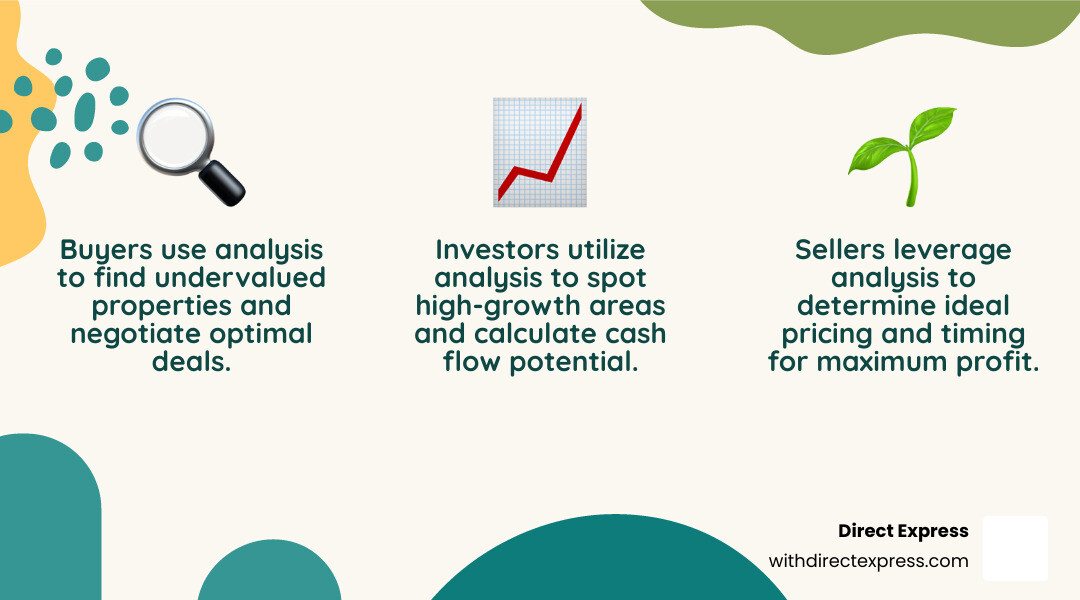
Market trends shift constantly, and staying ahead gives you a competitive edge. For buyers, this means strategizing negotiations and avoiding overpayment. For sellers, it helps with pricing homes correctly for quick and profitable sales. For investors, it identifies high-growth areas and undervalued properties to maximize returns.
I’m Joseph Cavaleri, and over two decades of leading real estate ventures across Florida, I’ve seen how real estate market analysis separates successful transactions from costly mistakes. My experience as Broker and CEO of Direct Express Realty has taught me that the most profitable opportunities often hide in plain sight within the data.
Decoding the Data: Key Terms in Market Analysis

Think of real estate market analysis as learning a new language. Once you understand what the numbers are actually saying, you’ll spot opportunities others miss and avoid costly mistakes.
Let’s start with how we measure home prices. The MLS® Home Price Index (HPI) is a sophisticated tool that tracks the value of a typical home over time, giving a clearer picture of price trends than simple averages. It helps us understand if prices are truly rising or falling in a consistent way.
Here’s where many get confused: Average vs. Median Price. The average price adds up all home sales and divides by the number sold. But if three homes sell for $350,000 and one sells for $1.5 million, the average jumps to $612,500—hardly representative. The median price finds the middle point where half the homes sold for more and half for less ($350,000 in this case), giving a much more accurate sense of the market.
Days on Market (DOM) is the market’s pulse rate, measuring the average time a property sits on the market before selling. A low DOM means homes are selling fast, favoring sellers. A high DOM suggests a slower market, giving buyers more negotiating power. A market like St. Petersburg seeing its DOM increase from 25 to 40 days signals a cooling trend.
The Sales-to-New-Listings Ratio (SNLR) creates a snapshot of supply and demand. A ratio above 60% indicates a seller’s market (more buyers than homes), while below 40% signals a buyer’s market. An Absorption Rate takes this further, calculating how long it would take to sell all current inventory at the current sales pace.
Property Types—detached homes, condos, and townhouses—often perform differently. In the same city, condo prices might be falling while single-family homes are appreciating, revealing hidden opportunities.
What Key Metrics Mean for You
Now that we’ve cracked the code, let’s see how this knowledge helps you. A Comparative Market Analysis (CMA) brings these metrics together, comparing a property to similar homes to determine its fair market value.
Understanding Market Temperature—whether it’s a Buyer’s Market, Seller’s Market, or Balanced Market—changes your entire strategy.
In a buyer’s market (low SNLR, high DOM), you have options and leverage. You can negotiate on price, ask for repairs, and take your time. For sellers, it means pricing competitively and ensuring your home stands out.
A seller’s market is the opposite. High demand and low inventory mean homes sell quickly, often with multiple offers. Buyers must be prepared to act fast with strong offers.
A balanced market is the sweet spot where neither side has a major advantage, often leading to sustainable, long-term growth.
If you’re considering property investment, these conditions directly impact rental rates and appreciation. Our Beginners Guide to Property Management can help you turn market knowledge into rental income.
Reading the Market’s Vital Signs: Core Metrics to Watch
Think of real estate market analysis like a health check-up. One reading is useful, but the combination of vital signs reveals the complete picture of market health. We focus on three critical signs: how fast homes are selling, their prices, and available inventory.
Here’s how different market conditions typically look:
| Condition | Sales-to-New-Listings Ratio (SNLR) | Days on Market (DOM) | Price Trends |
|---|---|---|---|
| Buyer’s Market | Below 40% | Higher | Prices tend to stabilize or gradually decline |
| Seller’s Market | Above 60% | Lower | Prices tend to increase quickly |
| Balanced Market | 40% – 60% | Moderate | Prices are stable, with modest growth or decline |
Understanding these patterns helps predict what’s next. For example, flattening price trends while inventory levels climb often signals a shift toward a buyer’s market. In the same city, detached homes might be cooling while condos stay hot, creating unique opportunities.
Analyzing Prices and Sales Volume
The heartbeat of any market is its prices and sales activity. We track both median sold price and average sold price because they tell different stories.
For example, in the Tampa Bay Area, the average home might sell for $450,000, but the median price is $415,000. That difference reveals that high-end sales are pulling the average up, while most buyers are paying closer to the median figure.
Year-over-year change helps us spot momentum. A 3% year-over-year price increase might sound modest, but when you see that sales volume jumped 10%, it paints a picture of a healthy, active market, not a stagnant one.
Breaking down by property type reveals where opportunities hide. Single-family homes in an area might see a 5% price increase, while condo apartments only rise by 1%. This spread tells investors and buyers exactly where different value opportunities exist. For investors, these variations can signal where cash flow is improving. Our team regularly helps clients explore apartment buildings for sale near me by analyzing each property type’s specific market dynamics.
Understanding Inventory and Market Speed
Market speed tells us if we’re in a sprint or a marathon. New listings represent fresh supply. If a market sees a 5% increase in new listings, it creates more choices for buyers.
But active listings—the total number of homes for sale—tell a bigger story. If active listings jump 20% year-over-year, it means homes are staying on the market longer, shifting the balance of power toward buyers.
Sold properties show actual demand. An increase in sales alongside growing inventory suggests a healthy, active market rather than a declining one.
The average Days on Market increasing from 30 to 40 days is a meaningful shift. Sellers need more patience, while buyers have more time for thoughtful decisions. The sale to list price ratio dropping from 100% to 98% represents thousands of dollars in negotiating room for buyers.
Reading these indicators helps you make smarter decisions. Hot markets typically have a DOM under 30 days and an SNLR above 60%. Cooling markets show a DOM over 40 days, an SNLR below 40%, and homes selling below asking price.
The Big Picture: Macro Factors Shaping Your Real estate market analysis
While local metrics are essential, smart real estate market analysis requires stepping back to see the bigger picture. If local data tells you what’s happening on your street, macro factors explain why it’s happening across the entire city and beyond.

These larger forces shape the market. Economic conditions are the foundation. When people have steady jobs and rising wages, they feel confident making big purchases like homes. When unemployment rises, even qualified buyers might hesitate.
Interest rates are perhaps the most powerful tool affecting real estate. When the Federal Reserve adjusts rates, it directly impacts mortgage affordability. Lower rates can spur demand, while higher rates can cool a hot market. It’s a perfect example of how macro factors can have powerful local effects.
Government policies can reshape markets. Federal or state initiatives designed to make homeownership more accessible, adjust lending standards, or offer tax incentives can create new opportunities for buyers and influence demand.
Demographics work more slowly but just as powerfully. Population growth, especially in states like Florida, drives long-term housing demand. When analyzing potential rental properties or considering your Mortgage options, understanding these demographic trends helps you make decisions that will pay off for years to come.
Key Factors for a Comprehensive Real estate market analysis
The economy’s health shows up in key indicators. Unemployment rates tell us how many people have steady incomes to support mortgage payments. Low unemployment and rising wage growth are generally positive signs for housing demand.
GDP growth and consumer spending reveal whether the economy is expanding. A growing economy typically means more jobs, higher incomes, and greater housing demand. When people feel financially secure, they’re more likely to buy homes or investment properties.
However, even good economic news can have complications. Inflation can erode purchasing power and prompt the central bank to raise interest rates to cool things down. It’s a delicate balance that affects everything from your monthly mortgage payment to rental rates.
Comparing Regional and National Trends
National real estate trends don’t always match what’s happening in your backyard. While the U.S. market might show certain patterns, high-growth markets in Florida often recover faster or grow more quickly than the national average due to strong in-migration and economic development.
Even within Florida, the Tampa market can have different dynamics than Orlando or Miami. The key is to use national trends as a baseline but focus on the specific data for your target area.
The remote work revolution has scrambled traditional real estate patterns. People who once needed to live near downtown offices can now choose homes based on lifestyle, boosting demand in suburban and rural areas. This shift creates opportunities for investors who understand the trends.
These urban vs. suburban shifts mean a property that was a tough sell five years ago could now be exactly what remote workers are seeking. The lesson is clear: successful real estate market analysis combines local data with a broader economic understanding. National trends provide the backdrop, but your specific market is writing its own story. This applies whether you’re looking at properties in Tampa Bay or even considering international options like Property for Sale Perthshire.
From Analysis to Action: A Strategic Guide
Understanding data is powerful, but translating it into effective action is where the magic happens. At Direct Express, we help you craft a strategy to achieve your real estate goals, whether you’re navigating the process of Buying a Home or exploring a sale.

Think of a good real estate market analysis as your personal roadmap. Our Buying a Home Checklist is a great tool to help you organize your actions as you move forward. Understanding market data transforms you from a hopeful participant into an informed, strategic decision-maker.
For Homebuyers: Finding Your Opportunity
For buyers, analysis is about finding the right property at the right price. Identifying undervalued areas is where the biggest wins happen. Look for neighborhoods with strong long-term potential—like upcoming infrastructure projects or new businesses—where prices haven’t yet caught up.
When it comes to negotiation power, knowing you’re in a buyer’s market (high DOM, low SNLR) changes everything. You might negotiate on price, ask for closing costs, or add protective contingencies. Knowing that homes in a specific area are selling for 98% of their asking price gives you a realistic starting point for offers.
Avoiding overpayment is where a thorough Comparative Market Analysis becomes your shield. The numbers keep you grounded and ensure you’re making a sound financial decision, not an emotional one.
Our team at Realty Buy is here to guide you through this process, ensuring you’re empowered with the best market intelligence available.
For Sellers: Maximizing Your Return
For sellers, market analysis is your strategic positioning tool. Optimal pricing strategy is crucial. Price too high, and your home gets stale; price too low, and you leave money on the table. A competitive price based on local comps and the current sales-to-listing price ratio is essential.
Timing the market requires understanding the bigger picture. While a seller’s market is ideal, good preparation and realistic expectations can lead to success in any market.
Highlighting in-demand features is more important than ever. With trends like remote work, a dedicated home office or flexible living space can be a major selling point. Presentation also matters—staging and professional photos help your home stand out.
When you’re ready to sell, our experts at List Your Home will provide a detailed market analysis to ensure your home sells successfully.
For Investors: Spotting Potential
Investors use market analysis to identify opportunities for long-term growth and consistent returns. Identifying growth areas requires looking at future potential, such as areas with projected job and population growth.
Calculating ROI is critical. The Cap Rate helps you compare the earning potential of different properties, while the Cash on Cash Return shows the actual return on the money you invested. These are your profit predictors.
Understanding rental demand and vacancy rates is essential. We’re seeing rental markets ease in some areas, which means investors need to be strategic about acquisitions and tenant retention. Effective Property Management is crucial for turning a good investment into a great one.
Future Gazing: How to Interpret Real Estate Forecasts
The future of real estate doesn’t have to be a mystery. While no one has a crystal ball, understanding expert forecasts and the trends shaping them is a key part of real estate market analysis. Think of it like weather prediction—we can spot the patterns that suggest what’s coming.
Housing starts tell us about future supply. In many parts of the U.S., there’s a shift in construction. While single-family home construction fluctuates with economic confidence, there’s been strong growth in purpose-built rental buildings. This indicates a long-term response to rental demand.
Resale market activity is often influenced by mortgage rates and the broader economy. A period of lower mortgage rates can release pent-up demand, as buyers who were previously on the sidelines re-enter the market. This can breathe new life into markets that have been quiet.
Rental market conditions are also shifting. In some areas, rising vacancy rates are beginning to slow the rapid rent growth seen in recent years. While rental affordability won’t improve overnight, the increase in new rental supply is gradually creating more options for tenants.
Looking at the bigger picture, many economists expect prices to stabilize or grow modestly after periods of volatility. It’s like a rubber band snapping back after being stretched—there’s an initial strong movement, then things settle into a new normal.
For a complete picture of what experts are predicting, you can review the latest Housing Market Outlook from major industry sources. And for ongoing market insights, keep checking Direct Express Insights.
Tools and Resources for Your Real estate market analysis
Having the right tools makes all the difference. Here are the resources we rely on to conduct thorough real estate market analysis.
Real estate board reports are your local market’s pulse check. Organizations like Florida Realtors® or your local association (like the Pinellas Realtor® Organization) provide detailed monthly statistics on everything from sales volumes to price trends.
The National Association of Realtors (NAR) offers the bird’s-eye view with their national perspective. Their monthly statistics and quarterly forecasts help you understand how your local market fits into national trends.
Local realtor expertise remains irreplaceable. We at Direct Express live and breathe the markets of St. Petersburg, Tampa Bay, Palm Harbor, and the surrounding areas. Boots-on-the-ground knowledge of which neighborhoods are developing or which areas are seeing an influx of new families is something algorithms can’t capture.
Government statistics from agencies like the U.S. Department of Housing and Urban Development (HUD) and the Census Bureau provide the foundational data that everything else builds on.
Finally, financial news and economic indicators keep you connected to the bigger forces. Interest rate announcements, inflation reports, and employment figures all ripple through the real estate market.
Conclusion
Navigating the dynamic world of real estate can feel like solving a complex puzzle, but with the right approach to real estate market analysis, you hold the key. We’ve journeyed through the essential metrics like MLS® HPI, DOM, and SNLR that reveal a market’s true temperature. We’ve seen how macro factors—from interest rates and economic conditions to demographic shifts—shape the entire landscape.
Knowledge truly is power in real estate. When you understand that a local market’s 98% sales-to-listing price ratio signals negotiation opportunities, or that a 20% increase in active listings creates a buyer’s market, you’re no longer making decisions in the dark. You’re strategically positioning yourself for success.
Whether you’re buying your dream home in Tampa, selling an investment property in St. Petersburg, or expanding your portfolio across Florida, these analytical skills transform you from a passive participant into an informed strategist. The difference between a good deal and a great one often lies in understanding what the numbers are really telling you.
At Direct Express, we’ve built our reputation on helping clients see beyond the surface numbers. Our integrated approach means your real estate market analysis extends through every aspect of your property journey. From mortgage solutions that align with market conditions to property management strategies that maximize returns, we’re here to turn insights into real results.
Ready to put your newfound market analysis skills to work? Take the next step in your real estate journey and explore investment opportunities with a team that truly knows the market inside and out.