



Understanding Fee-Based Property Management: What You’ll Really Pay
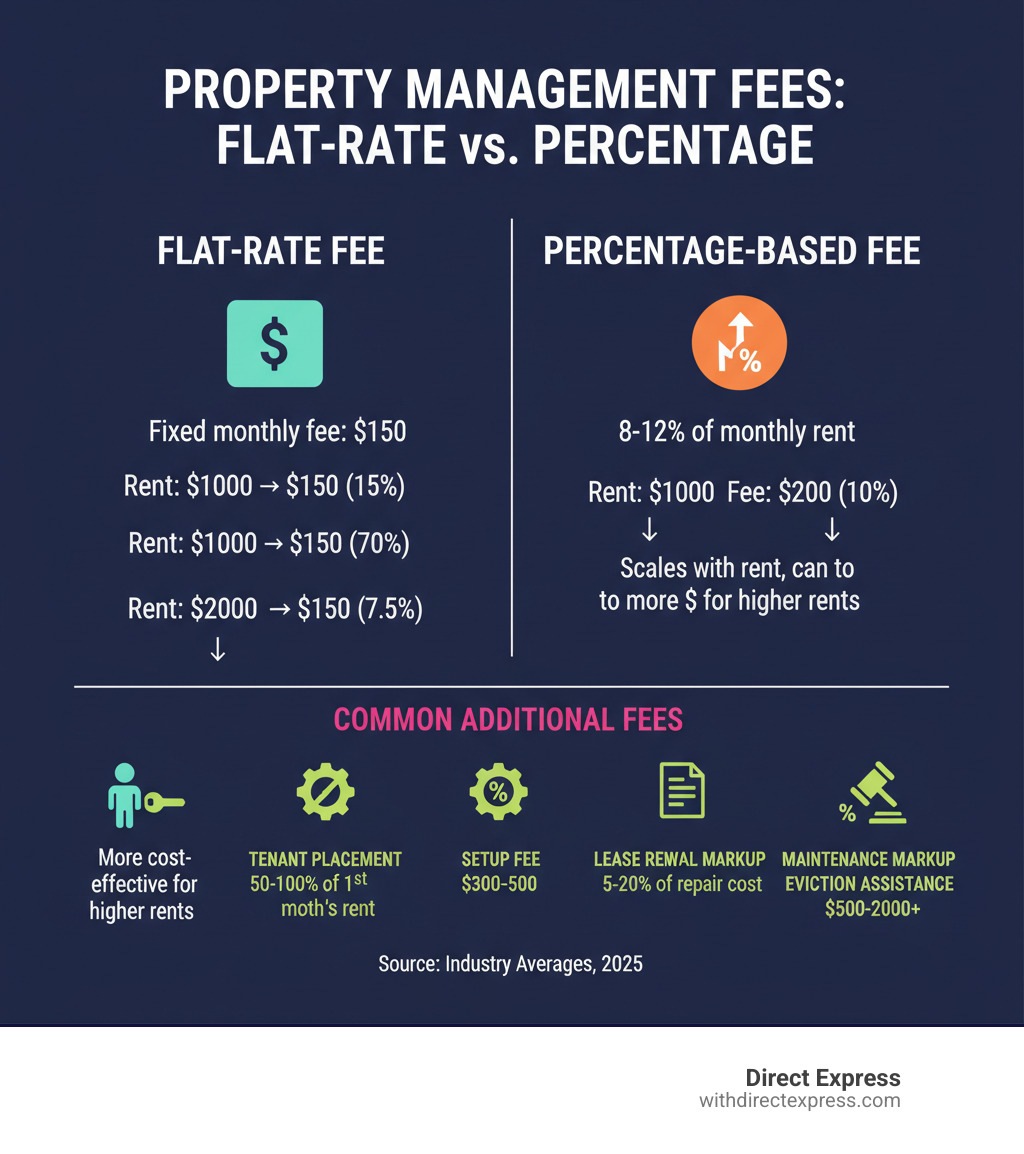
Fee based property management typically costs landlords 8-12% of monthly rent or a flat rate of $100-$200 per month. Beyond this base fee, you can expect additional costs like tenant placement (50-100% of first month’s rent), setup fees ($300-$500), and maintenance markups (5-20%).
Quick Fee Structure Overview:
- Flat-Rate Model: Fixed monthly fee ($100-$200) regardless of rent collected.
- Percentage Model: 8-12% of monthly rent collected.
- Common Add-Ons: Tenant placement, lease renewals, evictions, vacancy fees.
- Key Benefit: Professional management saves time and often increases rental income.
As a landlord, understanding what professional property management actually costs can be overwhelming. Fees range dramatically, and some companies advertise low monthly rates only to add surprise charges later. The key isn’t just finding the lowest price; it’s knowing exactly what you’re paying for and what will cost extra. It’s about determining whether a flat fee or a percentage of rent makes more sense for your property. The right partner doesn’t just cost you money—they make you money by reducing vacancies, attracting quality tenants, and protecting your investment.
I’m Joseph Cavaleri, CEO of Direct Express Realty and Direct Express Rentals, with over 20 years of experience in property management and real estate. I’ve seen how the right fee structure can maximize returns while the wrong one drains profitability. This guide will help you steer your options.
Decoding Fee-Based Property Management: Flat-Rate vs. Percentage Models
Fee based property management primarily uses two charging models: a flat monthly fee or a percentage of collected rent. Both provide essential services, but they impact your rental income and ROI differently. Understanding these fee structures is key to budgeting and choosing the most cost-effective solution for your properties in St. Petersburg, Tampa Bay, or Palm Harbor.
At Direct Express, we prioritize cost transparency. To learn more about our approach, explore our More info about our Property Management services.
What is Flat-Rate Property Management?
Flat-rate property management means you pay a fixed monthly fee, typically $100 to $200 per unit, regardless of the rental income. For example, you might pay $125 per month whether the property rents for $1,500 or $3,000. This predictability simplifies budgeting and expense forecasting.
This model is especially beneficial for properties with higher rents. The work to manage a $2,000 property is often the same as for a $4,000 one. For luxury rentals in areas like Lutz or Wesley Chapel, a flat fee can offer significant savings compared to a percentage-based model where higher rent automatically means a higher management fee.
What is Percentage-Based Property Management?
Percentage-based management is the more traditional model, where the manager charges a percentage of the monthly rent collected, usually between 8-12%. If your property rents for $2,000 a month with a 10% fee, you’d pay $200.
The theory behind this model is that it “aligns interests,” motivating the manager to secure the highest possible rent. However, the costs are variable, making budgeting less predictable, especially if rents fluctuate with market conditions in Tampa or Largo. While suitable for lower-rent properties, the fees can become substantial for higher-value rentals.
Cost Comparison: A Real-World Scenario
Let’s compare these two structures using a 10% percentage fee and a $150 flat fee.
| Monthly Rental Income | Percentage-Based Fee (10%) | Flat-Rate Fee ($150) | Monthly Savings (Flat-Rate) | Annual Savings (Flat-Rate) |
|---|---|---|---|---|
| $1,500 | $150 | $150 | $0 | $0 |
| $2,000 | $200 | $150 | $50 | $600 |
| $2,500 | $250 | $150 | $100 | $1,200 |
| $3,000 | $300 | $150 | $150 | $1,800 |
| $4,000 | $400 | $150 | $250 | $3,000 |
The table clearly shows that for properties with higher rental income, the flat-rate model leads to significant annual savings. A property renting for $2,000/month saves $600 annually with a $150 flat fee versus a 10% fee. The management workload doesn’t increase with the rent, so why should the fee? This is a core principle at Direct Express.
When comparing options, always consider your potential ROI. A transparent, all-inclusive fee might offer a better financial return than a cheaper service with hidden costs. For a deeper dive into these calculations, see A guide to calculating investment ROI.
The Complete Breakdown of Potential Property Management Fees
Beyond the base monthly fee, many companies have additional charges that can surprise landlords. This is why fee transparency is critical. When reviewing a management agreement, you must understand what’s covered in the base fee and what costs extra. At Direct Express, we believe in an upfront, transparent approach so you know what you’re paying for from day one.

The Monthly Management Fee
This core fee for your fee based property management service covers the day-to-day operations that keep your property running smoothly. It typically includes:
- Rent Collection: Ensuring timely payments and processing.
- Tenant Communication: Acting as the primary contact for all inquiries, requests, and complaints.
- Financial Reporting: Providing detailed statements of income and expenses for your records and tax purposes.
- Lease Management: Enforcing lease terms and handling administrative tasks for renewals.
For more on these fundamentals, see A Beginner’s Guide to Property Management.
One-Time and Situational Fees
These costs appear at specific times and should be clearly outlined in your agreement. Be aware of:
- Setup Fee: A one-time charge of $300 to $500 for account setup, initial inspection, and paperwork.
- Tenant Placement Fee: A significant fee, usually 50% to 100% of one month’s rent, for marketing, showings, screening, and lease preparation.
- Lease Renewal Fee: A $200 to $500 fee for negotiating and processing a lease extension with an existing tenant.
- Maintenance Markup: A 5% to 20% surcharge on vendor invoices for coordinating repairs. Always ask if this fee applies.
- Eviction Fee: A fee starting around $500 plus legal costs to manage the complex eviction process.
- Vacancy Fee: A monthly charge of $50 to $100 some companies bill to monitor an empty property.
- Other Fees: Look for charges like routine inspections ($100-$200), project management for renovations (around 10% of project cost), or early contract termination fees.
What Services Are Included in a Fee-Based Property Management Agreement?
A comprehensive fee based property management agreement should deliver a full suite of services to protect and maximize your investment. Key services include:
- Marketing and Advertising: Professional listings with high-quality photos distributed across multiple platforms to attract qualified tenants quickly.
- Thorough Tenant Screening: Comprehensive background checks, credit assessments, and employment/rental history verification to find reliable tenants.
- Full-Service Leasing: Handling all aspects of leasing, from showings to executing the lease agreement, while ensuring fair housing compliance.
- Maintenance and Repairs: Coordinating with vetted, reliable contractors who offer fair pricing. Our approach to Property Management and Maintenance ensures quality and cost-effectiveness.
- Regular Property Inspections: Move-in, periodic, and move-out inspections to document property condition and identify issues early.
- Legal Compliance: Navigating complex federal, state, and local landlord-tenant laws to protect you from costly legal mistakes.
- Financial Management: Detailed accounting, rent collection, and providing itemized monthly statements and tax documentation.
Making the Right Choice: Is It Worth the Cost?
After learning about fee structures and hidden costs, the main question remains: Is fee based property management worth it for your investment property?

For most landlords, especially those managing properties from a distance or with multiple units, professional management is a strategic investment. It saves time, reduces stress, and can maximize returns. Managing properties in St. Petersburg or Clearwater while living elsewhere is nearly impossible without professional help. Even local landlords find their time is better spent on their careers or growing their portfolio rather than handling tenant issues.
For guidance on fitting property management into your investment strategy, explore our Property Investment Help resources.
Advantages for Landlords
- Professional Expertise: Managers use market knowledge to set optimal rent prices, increasing your income.
- Cost-Effective Maintenance: Access to a network of vetted vendors ensures quality repairs at fair prices, saving you money over time.
- Reduced Vacancy & High-Quality Tenants: Professional marketing fills vacancies faster, and rigorous screening reduces the risk of costly problem tenants.
- Legal Protection: Managers stay current on complex landlord-tenant laws, protecting you from expensive legal mistakes and lawsuits.
- Consistent Cash Flow: Firm rent collection policies ensure more consistent and timely payments.
- Time Savings & Stress Reduction: Frees you from late-night calls, weekend showings, and tenant disputes, giving you back your personal time.
Potential Disadvantages and Limitations
- Cost: Management fees are an expense that reduces your net rental income, which can be significant for properties with thin profit margins.
- Loss of Control: Delegating day-to-day decisions can be difficult for hands-on landlords who prefer direct involvement.
- Finding the Right Fit: A poor match with a management company can lead to frustration and miscommunication, requiring careful vetting.
Is Fee-Based Property Management the Right Choice for Your Investment?
Consider these factors to decide if professional management is right for you:
- Portfolio Size: Managing multiple properties, especially across cities like Tampa and Lutz, becomes complex and time-consuming.
- Geographic Proximity: If you live far from your rental, professional management is almost essential for handling showings and emergencies.
- Personal Time: Do you have 10-20 hours per month to dedicate to management tasks, and is that how you want to spend your free time?
- Maintenance Skills: If you aren’t handy or lack a network of reliable contractors, a manager’s vendor relationships are invaluable.
- Financial Objectives: Are you scaling a large portfolio (management is key) or maximizing passive income for retirement (time savings are a priority)?
Answering these Key questions to ask a potential property manager can help clarify if this service aligns with your goals.
How to Select the Right Property Management Partner
Choosing the right property management partner is a crucial decision that impacts your investment’s profitability and your peace of mind. You are entrusting a valuable asset to them, so thorough vetting is paramount.

Start your research by exploring resources like Property Management Company Reviews, but reviews are just one piece of the puzzle.
Key Factors to Consider
When evaluating fee based property management partners, look beyond the monthly fee. Here’s what really counts:
- Local Market Knowledge: The manager must have deep insights into your specific market, whether it’s St. Petersburg, Tampa, or Palm Harbor. This expertise affects rental rates and vacancy times.
- Technology Use: Modern firms should use technology for efficiency and transparency, offering online owner portals, automated rent collection, and digital maintenance tracking.
- Communication Protocols: Understand their communication plan. How often will you receive reports? Do they offer 24/7 emergency response? Clear, consistent communication is essential.
- Legal Compliance: The manager must be an expert in state landlord-tenant laws and strictly adhere to Federal Fair Housing laws to protect you from costly lawsuits.
- Transparency: Demand a clear, written breakdown of all potential fees. A reputable company will be upfront about costs. If getting straight answers is difficult, consider it a red flag.
Where to Find and Vet Companies
Use these strategies to find a great property manager:
- Referrals: Ask other local real estate investors, your real estate agent, or your mortgage lender for recommendations. Word-of-mouth from trusted sources is invaluable.
- Real Estate Investor Groups: Online forums and local meetups are excellent sources for unfiltered feedback from other landlords.
- Online Search: Use online searches to identify local companies with professional websites and established track records. Look for affiliations with professional organizations as a sign of commitment to industry standards.
You’re looking for a strategic partner who will help protect and grow your investment. At Direct Express, we build relationships based on transparency, local expertise, and a commitment to your success.
Frequently Asked Questions about Property Management Fees
Here are answers to common questions landlords have about fee based property management.
Can I negotiate property management fees?
Negotiation is sometimes possible, especially if you own multiple properties. However, instead of focusing only on the monthly percentage, consider negotiating ancillary costs. You might get a reduced tenant placement fee for a longer contract or a waived setup fee for bringing multiple units. A good company values a fair, long-term partnership over a single transaction.
Are property management fees tax-deductible?
Yes, property management fees are typically considered a tax-deductible operating expense for rental property owners. You can generally deduct these fees from your rental income, reducing your taxable income. However, tax laws are complex. Always consult a qualified tax professional to ensure you’re taking full advantage of all applicable deductions. IRS Publication 527 is also a useful resource for understanding deductible rental property expenses.
What happens if a tenant doesn’t pay rent?
This is where a professional property manager is invaluable. A good manager has clear, legally compliant rent collection policies. When rent is late, notices are sent immediately, and late fees are applied per the lease. If the tenant still doesn’t pay, the manager initiates the eviction process correctly, following specific local and state laws to avoid costly delays and legal missteps. While thorough tenant screening minimizes this risk, a professional manager is equipped to handle non-payment swiftly and legally.
Conclusion: Investing in Peace of Mind
Understanding the different fee structures of fee based property management is about making a strategic investment in your property’s future and your own peace of mind. While the choice between a flat fee and a percentage model depends on your specific property, the right partner does more than just cost money—they make you money.
A good property manager reduces vacancies, secures high-quality tenants, steers complex laws, and manages maintenance cost-effectively. This protects your asset, maximizes returns, and frees you from the daily stresses of being a landlord.
At Direct Express, we’ve built our reputation on transparency and integrated services. As your complete real estate partner, we cover everything from buying and selling to property management and construction, all under one roof. We know the Florida market, from St. Petersburg to Parrish, and our approach is simple: clear pricing, honest communication, and dedicated service.
Choosing a manager is about securing a strategic ally invested in your success. It’s about knowing your investment is protected.
Ready to experience the difference that transparent, professional property management can make?
Contact us to learn more about our comprehensive Property Management solutions.