


Understanding the Real Cost of Hiring a Property Manager
Monthly property management fees are the primary cost of hiring a professional to manage your rental. They typically range from 8% to 12% of the monthly rent collected, with 10% being the most common rate. For a $1,500/month rental, this means a fee of $120-$180. This fee should always be based on rent collected, not rent due, to ensure your manager is motivated to keep the property occupied.
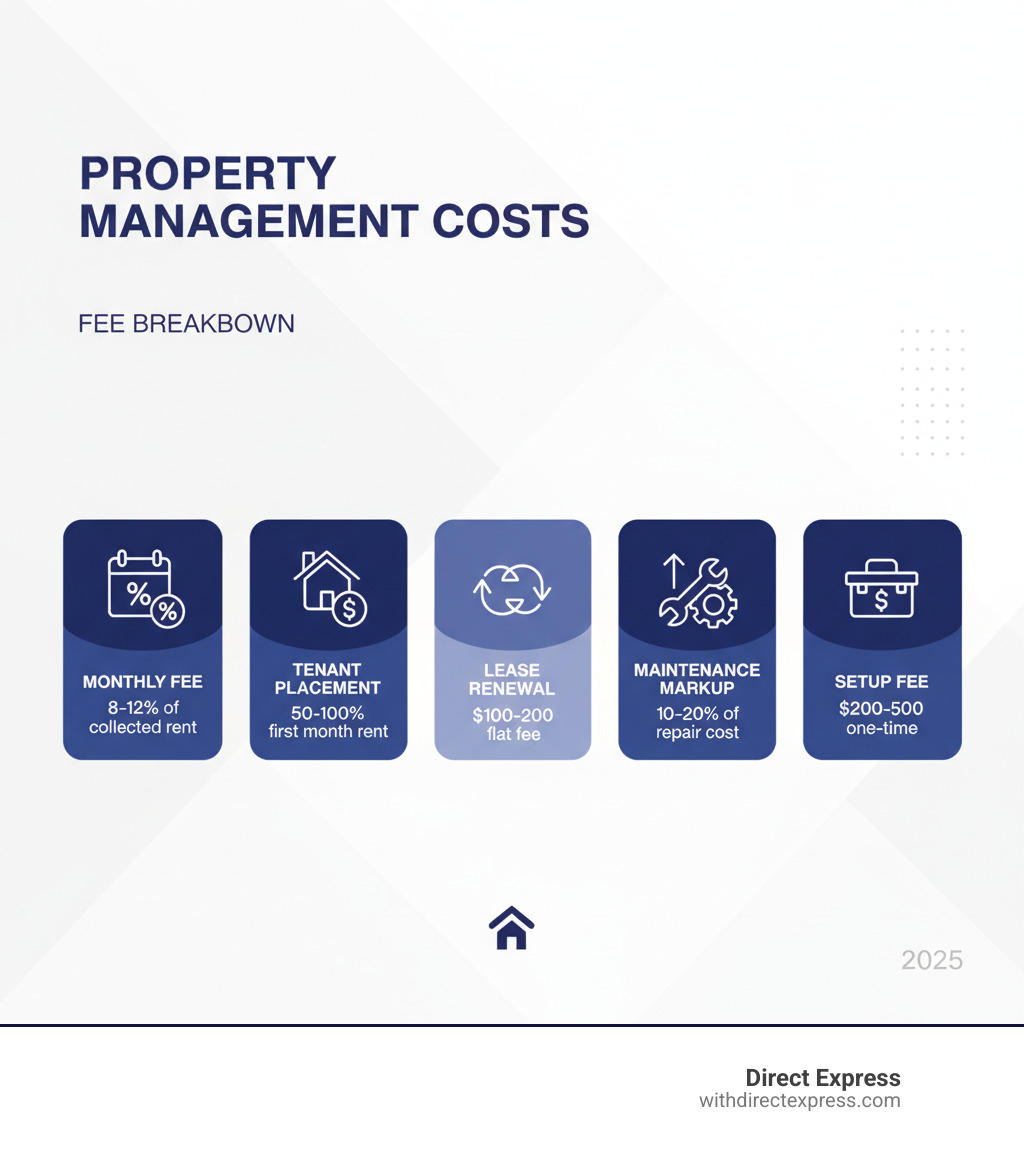
However, this monthly percentage is just one piece of the puzzle. Property owners should also budget for other common charges:
- Tenant Placement Fee: 50-100% of one month’s rent
- Lease Renewal Fee: $100-$200
- Initial Setup Fee: $200-$500
- Maintenance Markup: 10-20% on vendor invoices
The challenge for investors is navigating these costs to ensure they’re paying a fair price for quality service. Many owners find hidden charges after signing a contract, leading to frustration and lower profits.
As Joseph Cavaleri, CEO of Direct Express Rentals, I’ve seen how these fees impact an investor’s bottom line. Transparency is key. This guide will help you decode fee structures, spot hidden costs, and evaluate the true value of property management services.
Decoding the Two Main Fee Structures
When evaluating monthly property management fees, you’ll encounter two main models: percentage-based and flat-rate. Understanding them helps align your manager’s incentives with your financial goals.
Percentage-based fees are the industry standard, typically ranging from 8% to 12% of the monthly rent collected. For a property renting at $1,800/month with a 10% fee, you’d pay $180. The key phrase is “rent collected,” not “rent due.” This motivates your manager to find quality tenants quickly and keep the property occupied, as they only get paid when you do. This structure covers core services like tenant screening, rent collection, maintenance coordination, and financial reporting.
Flat-rate fees offer predictability, with a fixed monthly cost, often between $100 and $200 for a single-family home. This simplifies budgeting. However, the trade-off is a potential misalignment of incentives. A manager earns the same whether your property rents for $1,200 or $1,800, which may reduce the drive to maximize rent. It’s also crucial to verify what’s included, as some flat-fee models charge extra for services like tenant placement or inspections, which can negate the initial savings.
For those just starting, our Beginners Guide to Property Management covers these fundamentals in greater detail.
Here’s how these two approaches stack up:
| Feature | Percentage-Based Fees | Flat Fees |
|---|---|---|
| Pros | Aligns manager’s incentives with owner’s income—higher rent means higher fees for both of you. Often includes broader services within the percentage. Can be more cost-effective for lower-rent properties. | Predictable monthly cost makes budgeting simple. Easier financial planning with fixed expenses. Can be more cost-effective for higher-rent properties. |
| Cons | Fee fluctuates with collected rent. Can be higher for premium properties. Must verify it’s based on “rent collected” to avoid paying during vacancies. | Less financial incentive for manager to maximize rent or minimize vacancy. May include fewer bundled services, leading to more à la carte charges. Less flexible if your property’s needs change. |
| Best Suited For | Most residential rental properties, especially single-family homes and smaller multi-family units. Owners who want strong incentive alignment with their manager. | Owners with properties generating consistent, high rents where predictability matters most. Larger portfolios where flat rates per unit create efficiency. Properties requiring only basic management services. |
| Typical Property Types | Single-family homes, duplexes, condos | Single-family homes, smaller multi-family units |
Beyond the Monthly Fee: Uncovering Additional Costs
Your monthly property management fees are just the starting point. Like baggage fees on a flight, additional charges for specific services are common. Knowing what to expect prevents surprises and helps you budget accurately.

At Direct Express, we prioritize transparency, especially for services like Property Management and Maintenance, where unexpected costs can arise. Here are the common fees to look for:
Tenant-Related Fees
- Leasing or Tenant Placement Fee: This is the largest one-time fee, covering advertising, showings, and comprehensive tenant screening. It typically costs 50% to 100% of one month’s rent.
- Lease Renewal Fee: A smaller fee of $100 to $200 for the administrative work of renewing a lease with an existing tenant.
- Eviction Fee: If an eviction is necessary, managers charge $200 to $500 plus court costs to handle the legal process.
- Late Fee Share: Managers often retain 25% to 50% of any late fees collected from tenants. This doesn’t come from your pocket but reduces your late fee income.
Property-Related Fees
- Initial Setup Fee: A one-time charge of $100 to $500 to open your account, perform an initial inspection, and handle documentation.
- Vacancy Fee: Some companies charge a flat fee (e.g., $50-$100/month) to oversee an empty property. Many managers, including Direct Express, do not charge this, as it incentivizes them to fill vacancies quickly.
- Maintenance Markup: To cover the time spent coordinating repairs, managers typically add 10% to 20% to vendor invoices. A $500 repair might appear as $550-$600 on your statement.
- Reserve Fund: This is not a fee but your money held in trust ($250 to $1,000 per property) to cover minor, day-to-day repairs without needing your constant approval.
- Early Termination Penalty: If you end your contract early, expect a penalty, which could be a flat fee ($500-$1,000) or the equivalent of one to three months of management fees.
Understanding these potential costs upfront is key to calculating your true return on investment. Always ask for a complete fee schedule before signing a contract.
What Factors Influence Your Monthly Property Management Fees?
Management fees aren’t one-size-fits-all. Just as home prices vary between St. Petersburg and Lutz, several factors determine your rate. Knowing them helps you evaluate quotes effectively.

- Location: Urban centers like Tampa often have higher fees due to greater operating costs and complex regulations. Managers in communities like Parrish or Wesley Chapel may offer lower rates.
- Property Condition: A well-maintained, newer property is easier and cheaper to manage. Older homes requiring frequent repairs will command higher fees to account for the extra work.
- Level of Service: Comprehensive, hands-off management costs more than a-la-carte services. Full-service plans cover everything from marketing to maintenance, while basic plans may have more add-on charges.
- Number of Properties: Owners with multiple properties have negotiating power. Managing several units for one owner is more efficient, often resulting in volume discounts.
- Market Competition: In competitive Florida markets, companies vie for business with better rates and services. This is why obtaining multiple quotes is crucial.
How Property Type Affects Monthly Property Management Fees
The type of property you own also dictates the fee structure.
- Single-Family Homes: These are the most common rental type and typically fall into the standard 8% to 12% fee range. Management is straightforward, with one lease and one family.
- Multifamily Properties: Small buildings (2-4 units) are often priced like single-family homes. Larger apartment complexes benefit from economies of scale, with fees often dropping to 5% to 10% because it’s more efficient to manage multiple units at one location.
- Commercial Properties: Managing retail or office space requires specialized expertise. Leases are more complex and tenants are businesses. Fees for commercial properties in markets like Tampa typically range from 4% to 8%. Our team has specific experience in Commercial Property Management Tampa FL for investors in this market.
The Value Proposition: What Do You Get for Your Money?
Is hiring a property manager worth the cost? For most investors, the answer is a resounding yes. Monthly property management fees are an investment in time, peace of mind, and often, better financial returns.

Think of it as buying back your life—no more late-night emergency calls or awkward rent collection conversations. But the value goes deeper than convenience.
- Professional Tenant Screening: Thorough background, credit, and rental history checks significantly reduce the risk of problem tenants. A single bad tenant can cost thousands in lost rent and legal fees, making the management fee a form of insurance.
- Market Expertise & Higher Occupancy: Experienced managers know the Florida rental market, from St. Petersburg to Wesley Chapel. They use strategic pricing and marketing to minimize vacancy time, which directly boosts your income.
- Maintenance Coordination: Managers leverage a network of reliable, vetted contractors, often securing better pricing than an individual owner could. This saves you time and money, even with a standard markup.
- Legal Compliance: Landlord-tenant law is complex. A professional manager ensures compliance with state laws and federal regulations like the Fair Housing Act, protecting you from costly legal mistakes.
- Financial Reporting: You receive clear, detailed monthly and annual statements that simplify tax time. As a bonus, property management fees are a tax-deductible business expense.
Professional management transforms your rental from a second job into a passive investment. At Direct Express, we’ve seen this change countless times. Our comprehensive Property Management services are designed to improve your property’s performance and profitability. The real question isn’t whether you can afford professional management, but whether you can afford not to.
Frequently Asked Questions about Property Management Fees
Investors in Tampa, St. Petersburg, and across Florida often have questions about transparency and value. Here are straightforward answers to the most common concerns about monthly property management fees.
Can property management fees be negotiated?
Yes, fees are often negotiable, especially if you bring value to the table. You have leverage if you:
- Own multiple properties: Managing a portfolio for one owner is more efficient, often justifying a volume discount.
- Sign a long-term contract: A two or three-year commitment provides the manager with stable business, which can lead to better rates.
- Have a well-maintained property: A turnkey property requires less work, which can be a point of negotiation.
Always get multiple quotes to encourage competition, but the lowest price doesn’t always equal the best value. Service quality is paramount.
Are property management fees tax-deductible?
Yes. The IRS generally considers monthly property management fees and other related charges (like leasing and maintenance fees) to be fully tax-deductible business expenses for your rental property. This deduction reduces your overall taxable rental income. Professional management companies like Direct Express provide detailed annual statements that make it easy for you or your accountant to identify and claim these deductions. As always, consult a tax professional for advice specific to your situation.
How do fees for vacant properties work?
This is a critical contract detail. The best arrangement for owners is a fee structure based on “rent collected.” This means you do not pay a management percentage when the property is vacant, perfectly aligning your manager’s goals with yours: to fill the vacancy quickly.
Some companies charge a flat vacancy fee (e.g., $50-$100/month) to cover ongoing marketing and property checks. Avoid contracts that charge fees based on “rent due” or anticipated rent, as you would be paying for management on a property generating no income. Always ask, “What do I pay if my property is vacant?” and get the answer in writing.
Conclusion: Making a Smart Investment in Property Management
You now have the knowledge to confidently evaluate monthly property management fees, from the standard 8-12% to the various additional charges. These fees are not just an expense; they are a strategic investment in your property’s success and your own peace of mind.
Proper management protects your asset through professional tenant screening, timely maintenance, and crucial legal compliance. It turns a hands-on job into a passive investment, freeing you from late-night calls and landlord duties. For property owners across Florida, from Tampa to St. Petersburg, that value is immeasurable.
Transparency is the cornerstone of a good partnership. A manager who is upfront about their fee structure and aligns their success with yours is invaluable. At Direct Express, we’ve built our reputation on this straightforward approach. Our unique, integrated model brings property management, construction, mortgages, and real estate sales under one roof, creating seamless, efficient service for our clients.
Ready to partner with a team as committed to your success as you are? Learn more about our comprehensive Property Management services and find how Direct Express can help you maximize returns while minimizing headaches.